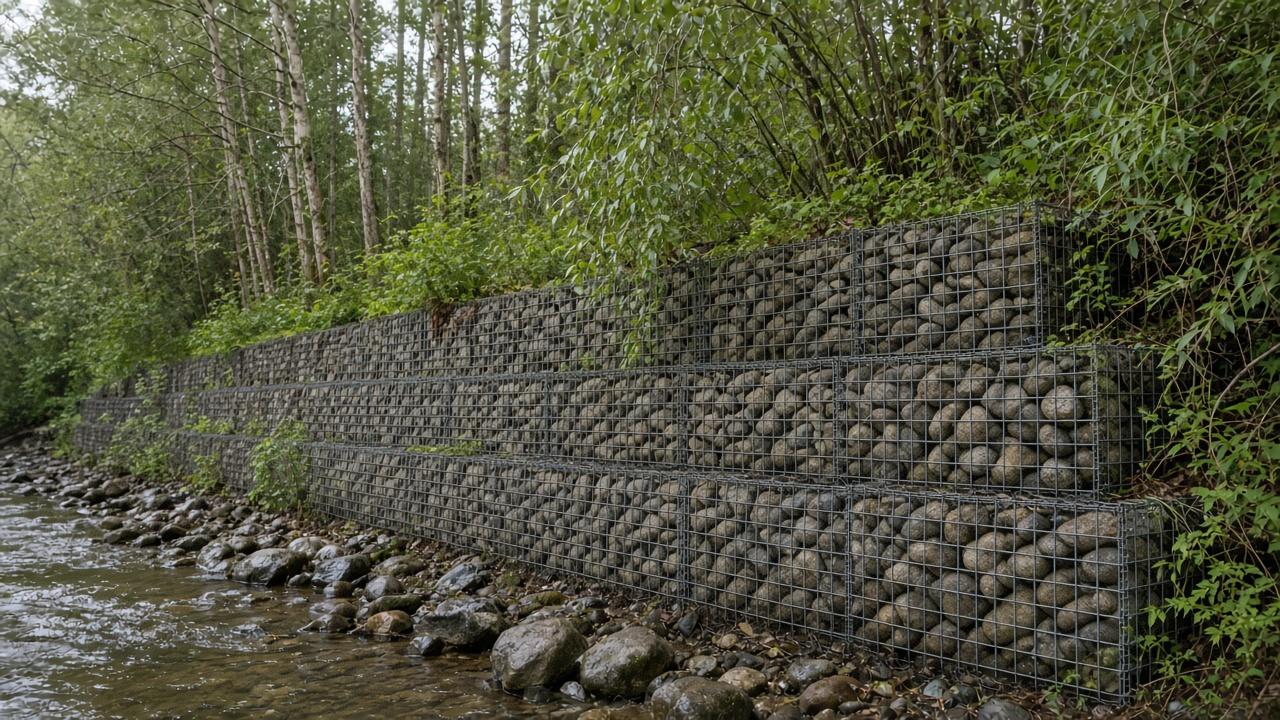
Gabion retaining walls are wire-mesh baskets filled with rock — typically river cobble, quarry stone, or recycled concrete rubble — stacked to form a permeable, gravity-resisting structure. They're among the oldest engineered retaining systems in use, dating back to military fortification applications in the 19th century, and they remain highly effective for specific applications where their permeable nature and mass-gravity behaviour are advantages.
In Abbotsford and the Fraser Valley, gabion walls are most commonly specified for creek bank stabilisation and riparian erosion control, steep slope stabilisation where hydrostatic pressure would overwhelm an impermeable wall, industrial and commercial sites where aesthetics are secondary to performance, and properties with natural or existing rock that can be incorporated into the fill.
A gabion wall allows water to pass through freely — there is no hydrostatic pressure buildup behind a well-designed gabion installation. This makes them particularly well-suited to the high-rainfall Fraser Valley climate and to sites adjacent to watercourses. Contact Abbotsford Retaining Wall Pros for a free assessment.
What Makes the Difference
Wire Mesh Specification
Not all gabion mesh is equal. The standard for permanent infrastructure applications is hexagonal double-twist galvanized wire mesh, typically 80×100 mm aperture, 3–4 mm wire diameter. Galfan-coated (zinc-aluminium alloy) or PVC-coated mesh provides significantly better corrosion resistance in wet, creek-adjacent environments. We specify and source appropriate mesh for the exposure class of each project.
Rock Fill Selection and Density
Gabion fill rock should be at least 1.5x the mesh aperture size — for 80×100 mm mesh, minimum rock size is 150 mm. River cobble is ideal for aesthetics and durability; quarry stone is more angular (better interlock, potentially lower void ratio). Avoid soft or friable stone that will break down under water and freeze-thaw cycling. Void ratio in a gabion basket typically runs 30–40%, so actual rock volume needed is 25–35% more than the basket volume.
Basket Assembly and Bracing
Gabion baskets are assembled on-site, unfolded and wired together at the vertical joints. Internal bracing wires are tied across the basket at intervals to prevent the basket from bulging when filled. Baskets must be filled carefully — angular stone packed tight at the exposed face for aesthetics and gradual filling in the back to avoid mesh distortion. The top is folded and tied closed under tension.
Stepped Wall Design
Gabion walls are almost always designed as stepped structures — each basket course set back from the one below, creating a terraced profile. A typical setback is half a basket width (300 mm for a 600 mm basket) per course, which produces a roughly 45-degree overall slope. This is both structurally rational and visually natural. Very steep gabion walls that lack adequate setback become unstable and prone to overturning.
Technical Specifications
- Standard basket dimensions: 1.0 m × 1.0 m × 2.0 m (H × W × L); custom sizes available
- Wire mesh: hexagonal double-twist, 80×100 mm aperture, 3 mm galvanized or Galfan-coated wire
- PVC coating: 0.5 mm minimum on wire in aggressive environments (brackish, chemical exposure)
- Rock fill: minimum 1.5× mesh aperture (150 mm minimum for 100 mm aperture)
- Void ratio: 30–40% — factor into rock volume calculations
- Course setback: 300–450 mm per course for gravity stability
- Internal bracing wires: every 1/3 basket length at mid-height
- Creek bank applications: riparian setback compliance per DFO/FLNRORD requirements
Common Questions
How long do gabion walls last?
Galvanized gabion wire in a moderate exposure environment (not salt-laden air, not high chemical exposure) typically has a service life of 20–30 years. Galfan-coated wire extends this to 50+ years. Rock fill is effectively permanent. On old galvanized gabion walls, the wire can be replaced in place by refilling a new mesh basket around the existing rock — a significant advantage over walls that require full demolition to rebuild.
Are gabion walls suitable for residential properties?
Yes — gabion walls work well in residential settings, particularly on large properties with natural character, rural acreages, or creek-adjacent lots. They're less suited to tight urban front yards where a clean aesthetic is desired. Many Abbotsford properties east of town — Sumas Mountain, Bradner, Mount Lehman — are ideal gabion candidates.
Do gabion walls need permits?
Structural gabion walls over 1.2 m in exposed height follow the same permit requirements as other wall types under the City of Abbotsford's Building Bylaw and the BCBC. Creek-adjacent work additionally requires review under BC's Riparian Areas Protection Regulation and may require a DFO referral. We assess regulatory requirements as part of the scoping process.
Got a creek bank, a steep slope, or a high water table situation in Abbotsford? Gabion walls might be exactly the right tool. Give us a call and let's assess your site.
Use the form on this page or call us directly. We're happy to talk through your project.