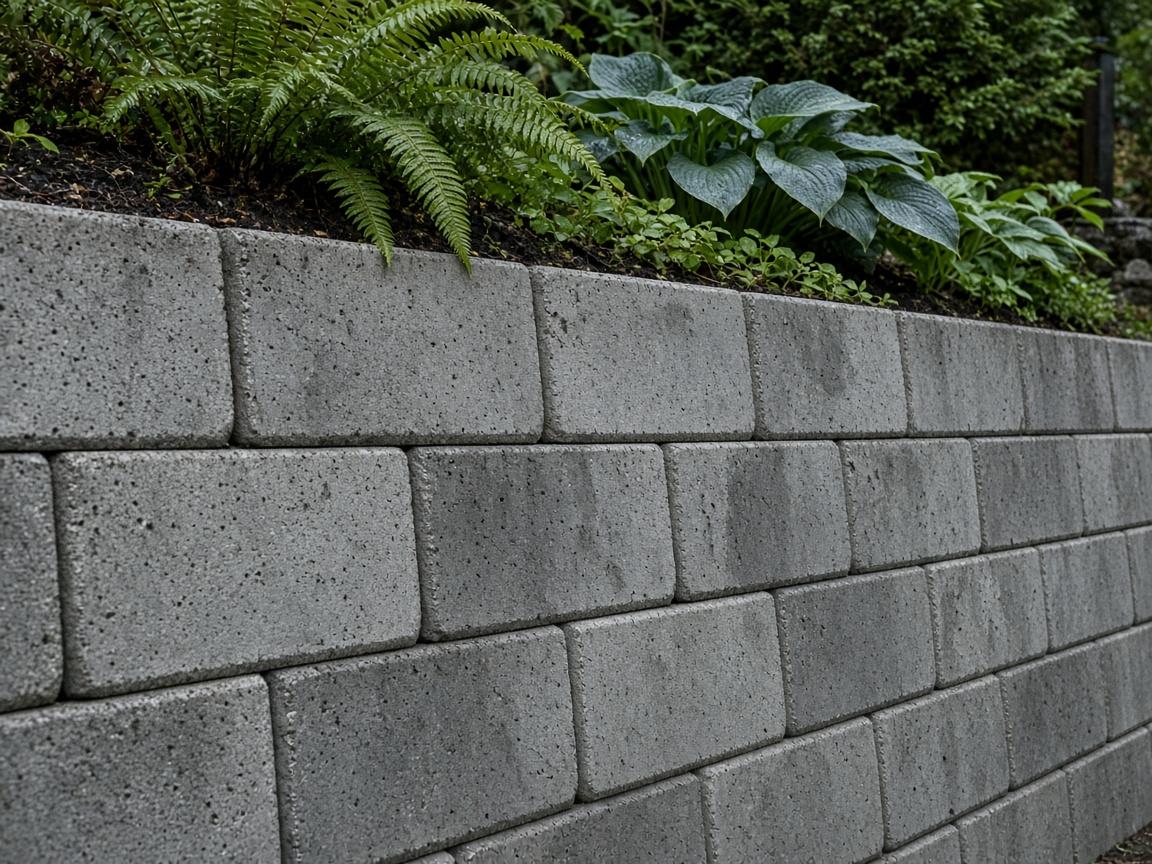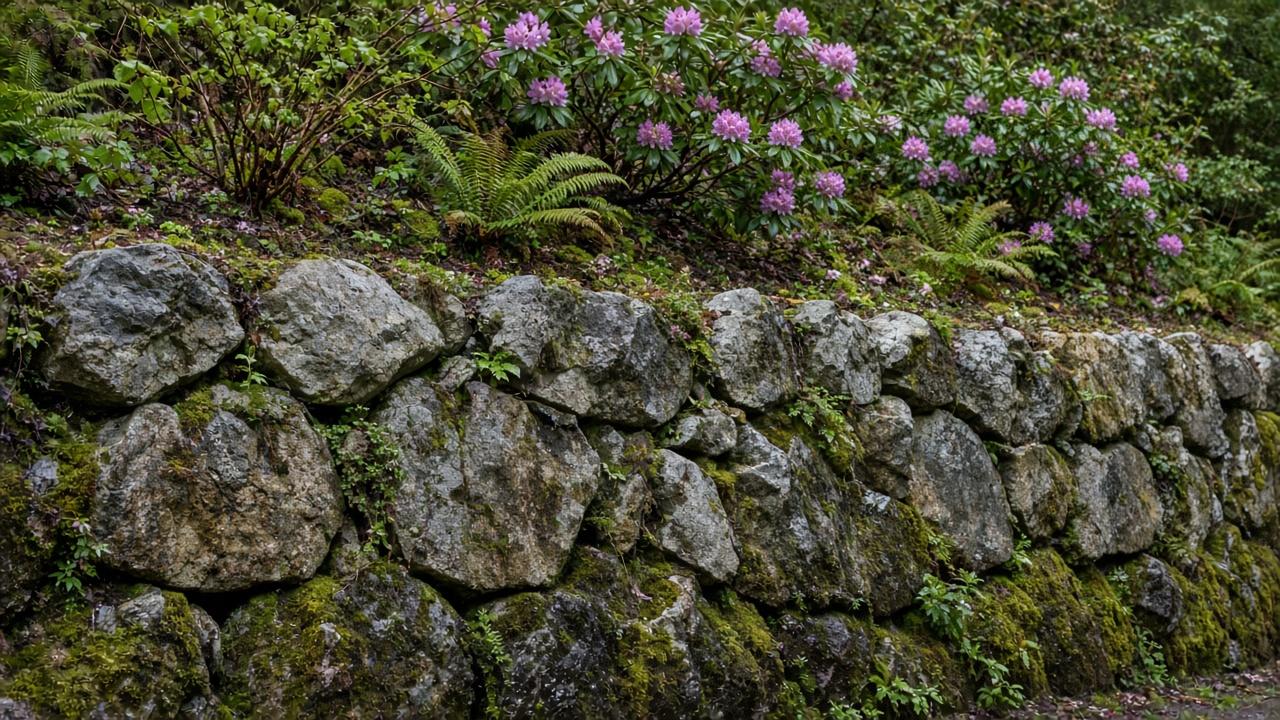
Natural stone retaining walls are among the most beautiful and enduring structures you can put on a property. A well-built fieldstone or armour stone wall in the Pacific Northwest doesn't just age gracefully — it gets better. Moss and lichen establish on north-facing stone faces within a few years, and native ferns colonize the joints, producing a wall that looks like it's always been part of the landscape.
There are two distinct categories of natural stone retaining walls: dry-stack and mortared. Dry-stack walls rely on the weight, shape, and interlocking of the stone for structural integrity — no mortar, no adhesive. Mortared walls use mortar in the joints to add cohesion and weatherproofing. Each has strengths suited to different applications and aesthetic preferences.
Armour stone walls — built with large individual boulders typically in the 300–800 kg range, placed by excavator — are a third category. These are the most structurally robust natural stone wall type and are commonly used for large height requirements, creek bank stabilisation, and commercial applications in the Abbotsford area. Contact Abbotsford Retaining Wall Pros for a free assessment.
What Makes the Difference
Dry-Stack Wall Engineering
A dry-stack stone wall is a gravity structure — its stability comes from mass and interlocking. The key principles: larger, heavier stones at the base; each stone bedded level and tight with minimal rocking; each stone overlapping two joints below (running bond); wall battered at 1:4 to 1:6 (15–25 degrees from vertical); tie stones extending through the wall every 1.5–2 m². Drainage through the joints is inherently better than a mortared wall, making dry-stack excellent for wet Fraser Valley sites.
Stone Selection for the Pacific Northwest
We source regional stone where possible — Lower Mainland fieldstone, granitic quarry stone, and basalt are all available within the Fraser Valley market. Regional stone naturally complements the local landscape aesthetic. Avoid soft, layered sedimentary stones (sandstone, some limestones) in BC's wet climate — they absorb water, freeze, and spall. Granite, basalt, and hard quartzite are the right choices for Abbotsford's climate.
Armour Stone Placement
Armour stone boulders — typically 0.5 to 2 tonnes each — are placed by excavator arm using nylon straps or a rock grapple. Proper placement requires understanding how boulders interlock: wide faces forward, slight backward tilt (batter), each boulder touching and supported by the ones adjacent to it rather than teetering on a point contact. An experienced operator can read stone shapes and place them efficiently; an inexperienced one produces an unstable, poorly fitted wall that moves after the first frost.
Mortared Stone Walls
Mortared stone walls are stronger in compression but less drainage-friendly than dry-stack. They require expansion joints at 3–4 m intervals to accommodate thermal movement without cracking. Mortar joints should be tooled slightly recessed (not flush or proud) so that water runs off the stone face rather than collecting on the joint. We use exterior-grade Type S mortar appropriate for BC's wet climate and ensure weep holes are included at the base course.
Technical Specifications
- Dry-stack batter: 15–25 degrees from vertical (approximately 1:4 to 1:6 ratio)
- Base course: largest available stone, minimum 2x the depth of smaller courses
- Running bond: each stone laps at least 1/3 of the stone below on each side
- Tie stones: at least every 1.5 m² of wall face, extending full wall width
- Infill hearting: tightly packed small stone filling the wall core on wider walls
- Armour stone: 0.5–2 tonne boulders placed by 5–10 tonne excavator with rock grapple
- Mortared walls: Type S mortar, expansion joints at 3–4 m, weep holes at 1.8 m centres
- Regional stone sources: Lower Mainland quarries, river fieldstone suppliers
Common Questions
How long does a natural stone retaining wall last?
A properly built dry-stack stone wall is essentially permanent — there are stone walls in Britain and Ireland still standing after 300+ years. In the Fraser Valley climate, even modest stone walls routinely outlast the houses they serve. The main threats are root damage from large trees (which can shift stone) and undermining from erosion if drainage is neglected at the base.
Is a dry-stack stone wall as strong as a concrete block wall?
For modest heights (under 900 mm) with moderate backfill and no surcharge loading, a well-built dry-stack wall is entirely adequate and arguably more durable due to its superior drainage. For taller walls, higher loads, or walls near structures, we evaluate the site and may recommend armour stone or a hybrid approach. It's always a site-specific assessment.
Can you source local Fraser Valley stone?
Yes — Lower Mainland quarries supply granite and basalt, and river-run fieldstone is available from several suppliers in the region. Local stone is almost always the better aesthetic choice because it matches the local landscape naturally. We pass material sourcing cost directly to the client at our supplier pricing.
Want a natural stone retaining wall that looks like it belongs on your Abbotsford property? Let's talk about stone type, style, and what'll work for your slope.
Use the form on this page or call us directly. We're happy to talk through your project.