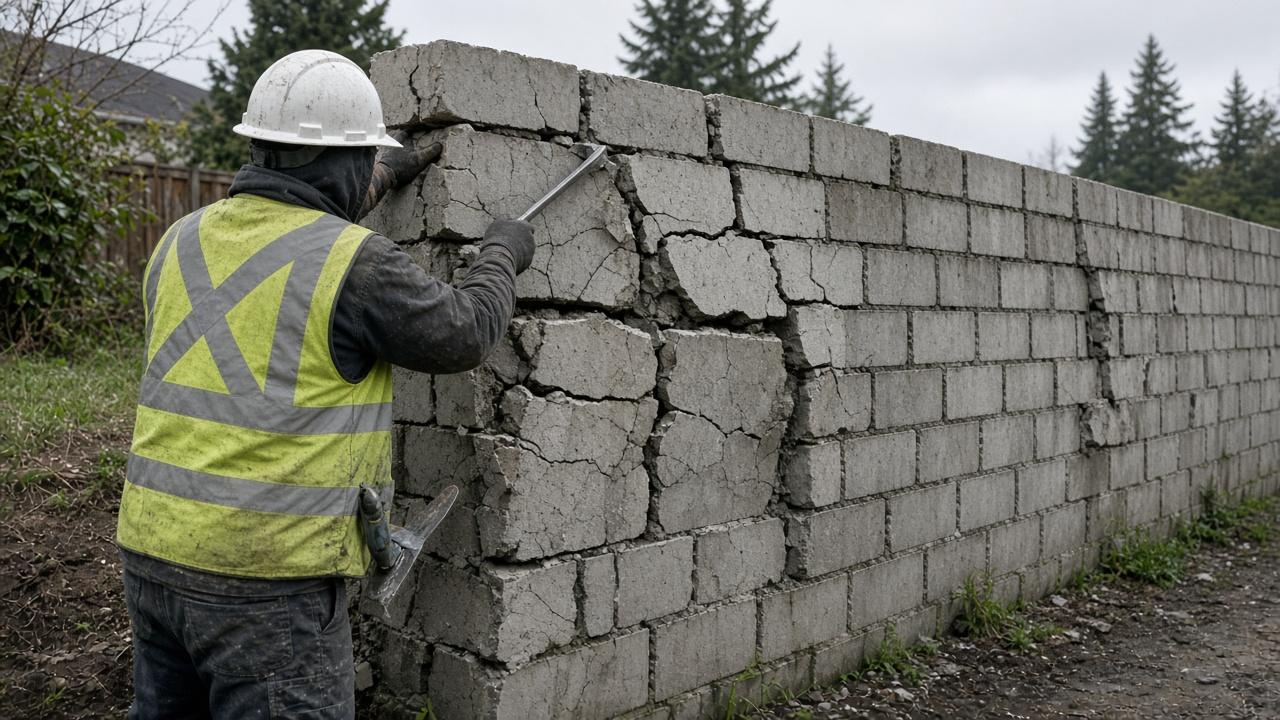
Retaining walls don't fail overnight — they give plenty of warning signs if you know what to look for. A wall leaning more than 2–3 degrees from vertical, cracks wider than 3 mm, efflorescence (white mineral staining) running down the face, weep holes that have stopped weeping despite rain, or blocks that have visibly shifted out of alignment all indicate that something needs attention.
The tricky part with retaining wall repair in Abbotsford is that the visible symptom is almost never the root cause. A leaning block wall isn't caused by defective blocks — it's caused by drainage failure, inadequate geogrid embedment, or a footing that wasn't deep or wide enough. Fixing only what you can see without addressing the underlying cause means the repaired wall will fail again, typically faster than the original.
Our repair process starts with diagnosis. We assess wall movement, probe behind the wall where accessible, inspect drainage outlet function, and look at the site's water flow patterns. Only after understanding why the wall is failing do we recommend a repair approach — which might be anything from cleaning and sealing a drain outlet to a full rebuild with upgraded drainage. Contact Abbotsford Retaining Wall Pros for a free assessment.
What Makes the Difference
Differential Settlement
Block walls that have settled unevenly — one section lower than another — indicate soft spots in the leveling pad or subgrade. Usually this happens where water has accumulated (from poor drainage) and saturated the soil, reducing its bearing capacity. Repair requires excavating the affected section, re-compacting or replacing the subgrade, and releveling the base. Simply pushing settled blocks back up without fixing the water intrusion means the same settlement recurs.
Bulging and Forward Movement
A wall face bulging or leaning forward is experiencing active lateral earth pressure that exceeds its resistance. This can be due to drainage failure (hydrostatic pressure), surcharge loading that wasn't accounted for in the original design, or missing/inadequate geogrid. If caught early — less than 25–30 mm of movement — targeted repair may be possible. Advanced movement often requires a rebuild.
Mortar Joint Repair on Stone and Concrete Block
Mortared walls develop joint failures over time as mortar carbonates and weathers. Repointing — raking out deteriorated mortar to a depth of 20–25 mm and replacing with fresh Type S mortar — restores weatherproofing and joint cohesion. Repointing on an otherwise-sound wall can significantly extend service life. It's a maintenance task, not an emergency, but one worth doing every 15–25 years on mortared walls.
Drainage System Restoration
If a wall's drainage system has failed — typically a blocked perforated drain tile or a clogged gravel zone compacted by poor backfill — restoring drainage may be possible without disturbing the wall face. We can excavate the backfill from above the wall (if accessible), flush and jet the drain tile, replace gravel fill, and add a drainage composite layer before compacting new topsoil. This is far less disruptive than a full rebuild when the wall face itself is still sound.
Technical Specifications
- Crack assessment: cracks < 2 mm — monitor; 2–5 mm — evaluate cause and repair; > 5 mm or actively growing — urgent assessment
- Lean measurement: >15 mm out-of-plumb on a 1 m wall — investigate; > 25 mm — active concern; > 50 mm — rebuild territory
- Drainage restoration: 50 mm drain jet at 700 psi can clear 80–90% of blocked perforated pipe without wall disturbance
- Mortar repointing: rake joints to 20–25 mm depth, pre-wet surface, Type S mortar, tooled slightly recessed
- Block re-pinning: replace broken pins on Versa-Lok style walls; use SRW adhesive on Allan Block cap failures
- Geogrid retrofit: possible on accessible walls with adequate embedment zone; requires exposing the fill from above
- Weep hole clearing: rod or jet from face; confirm clear by flowing water from above
Common Questions
My retaining wall is leaning but hasn't fallen — is it urgent?
It depends on the degree of lean and what's behind or in front of the wall. A wall showing 15–25 mm of forward lean that has been stable for years is different from a wall that moved 25 mm in one season. Walls that are accelerating in movement, or walls with significant property above them, should be assessed promptly. Walls that retain driveways or are adjacent to structures are considered higher consequence — they deserve faster action.
Can you repair a retaining wall without tearing it down?
Sometimes, yes — but it depends on the cause and severity. If the wall face is still structurally sound and drainage is the only failure, we can often restore drainage without touching the wall. If the wall has moved significantly, partial or full dismantling and rebuild may be the only way to address the root cause properly. We give honest assessments — repair when repair is appropriate, rebuild when it's necessary.
How much does retaining wall repair cost in Abbotsford?
Minor repairs — repointing, drain clearing, settling one or two blocks — can be a few hundred dollars. Major repairs involving partial dismantling and drainage upgrade on a 10–15 m wall might run $3,000–$8,000. Full rebuilds are priced similarly to new installation. We assess your wall and provide a fixed-price quote before any work starts.
Got a leaning, cracking, or bulging retaining wall in Abbotsford? Don't wait until it fails completely. We'll assess it and give you honest options.
Use the form on this page or call us directly. We're happy to talk through your project.